

Demand-led cleaning: the saving you book in 2026, the bill you get in 2027
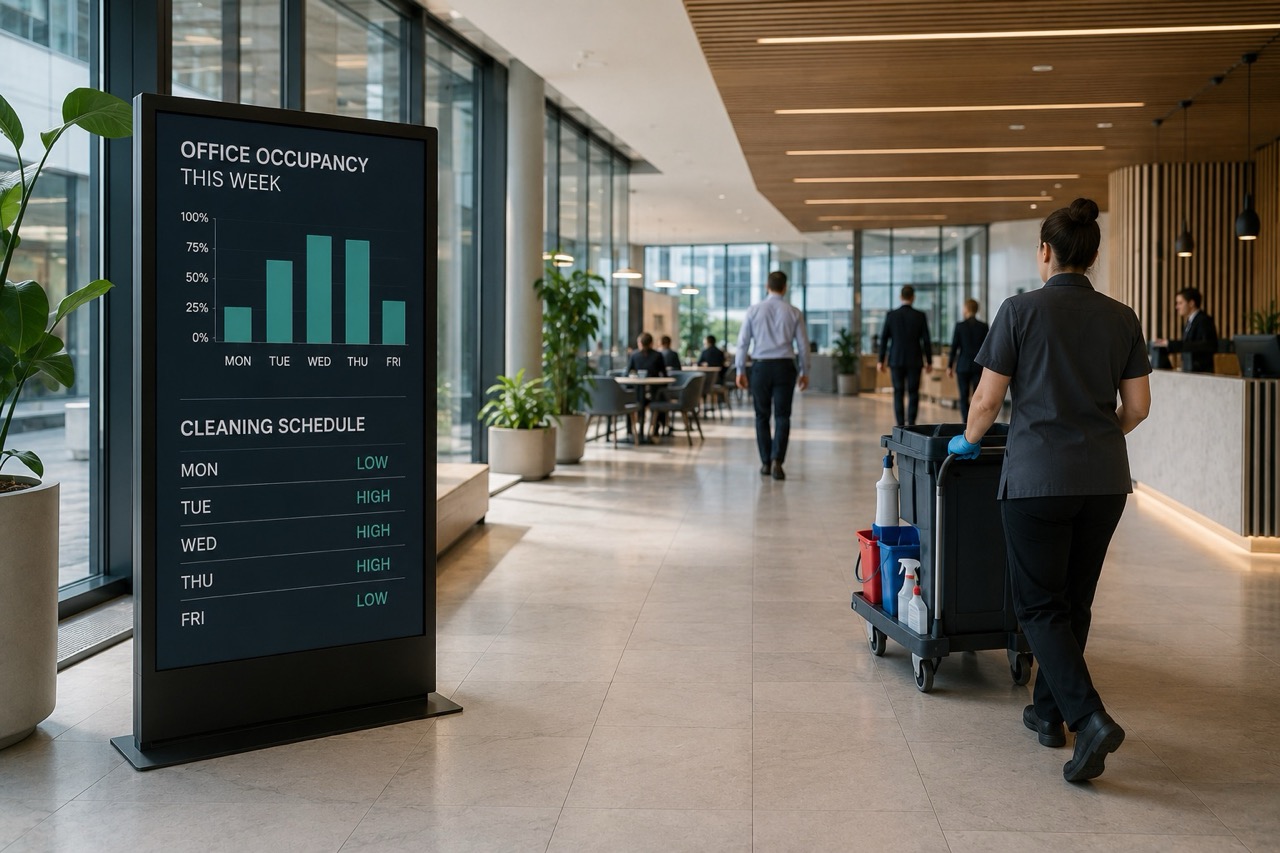
Office attendance patterns have settled into a shape nobody designed, and the sector has arrived at a settled answer to it.
Flex the specification to the occupancy data. Clean less on Mondays. Trim the catering offer on Fridays. Let the sensors decide where the labour goes. IWFM’s guidance on smarter space planning is the reasonable end of this thinking; the tender market is running well ahead of it.
It is a tidy argument, and parts of it are right. But most of the saving it promises is not a saving at all. It is a transfer. Volatility, risk and ultimately income all move from the client’s budget line to the supplier’s roster and the cleaner’s payslip. Worth understanding clearly, because the law is about to make that transfer considerably harder to execute.
Why buyers are reaching for it
Start with the pressure, because it is real and it is not going away.
The National Living Wage rose to £12.71 an hour on 1 April 2026, up from £12.21. That followed the increase in employer National Insurance to 15% with the secondary threshold cut to £5,000. The change fell disproportionately on exactly the kind of workforce soft services depend on: part-time, multiple-jobholding, clustered just above the old threshold. In one industry survey, over 97% of cleaning professionals said the NIC increase had materially affected day-to-day operations, and close to 90% cited inflationary pressure more broadly.
Do the arithmetic on a soft services line and there is very little air left. Once employer NI, pension, holiday cover, supervision, insurance and materials are loaded onto £12.71, a charge-out rate much below £15 to £16 an hour has effectively no margin in it. Suppliers know this. Buyers with flat budgets know it too. Something has to give, and the specification is the most obvious lever in the room.
Meanwhile the demand signal has genuinely changed. UK office attendance has held above 40% since early 2026, the highest since the pandemic began on Remit Consulting’s numbers, peaking at 44.2% in February. JLL’s 2026 occupancy benchmark found 62% of organisations now mandate a fixed number of office days, up from 49% a year earlier. But the aggregate is misleading. The attendance is concentrated: Tuesday to Thursday, with Wednesday typically the peak. Nationally the midweek figure runs at roughly double the Friday one, and on individual estates the spread is a good deal wider than that.
So the logic writes itself. Variable demand, variable service, variable cost.
The efficiency case, stated fairly
It deserves to be stated properly rather than caricatured, because the strongest version of it is sound.
Output specifications describe what the environment should look and feel like rather than dictating the hours required to get there. Sensor-triggered work orders replace fixed schedules with condition-based ones. Vendors in the space report substantial numbers. One platform claims a 23% cost reduction alongside improved quality, though that is a supplier’s own figure and should be read as such.
And the underlying complaint is legitimate. Deep-cleaning an empty floor on a Friday morning because the schedule says so is waste, and defending it on the grounds that it protects someone’s hours is not a serious position.
If the argument here were simply “don’t change anything,” it would not be worth making.
Where the cost actually goes
The problem is not the diagnosis. It is what happens to the labour on the other side of it.
A specification that varies with occupancy produces a roster that varies with occupancy. A roster that varies produces income that varies. And the workforce absorbing that variation is one that already cannot hold onto people. Turnover across UK commercial cleaning is severe by any benchmark, with industry averages commonly put above 40%. Samsic, one of the providers to have published its own figures after investing seriously in retention, brought its rate down from 52% in 2022 to 30.1% in 2024. That gives some sense both of what good looks like and of how far it sits from the norm. The recruitment pressure behind those numbers is well documented: pay, a shrinking pool of people willing to take fragmented hourly work, and a labour supply that has not recovered since the pandemic.
Ask what a variable roster does to that. The worker whose Monday and Friday hours have been designed out does not simply accept a smaller week. They take a second job, or they leave. Either way, the client’s exposure shows up in the place they least want it: on the peak days, when the building is full, the visitors are in, and the cover is being filled by an agency operative who has never seen the floor before.
That is the transfer. The budget line falls. The service risk rises, and it rises specifically at the moment of maximum visibility. Whether that trade is worth making is a legitimate commercial question. But it should be made knowingly, and priced, rather than booked as a clean efficiency.
And then there is the law
This is the part that turns a judgment call into a timing problem.
The Employment Rights Act 2025 received Royal Assent on 18 December 2025, with a staged rollout running through 2026 and 2027. The zero-hours package lands together in 2027, and it lands as a set: a duty to offer zero-hours and qualifying low-hours workers a guaranteed hours contract reflecting the hours they actually work across a reference period, a right to reasonable notice of shifts, and compensation where shifts are cancelled, moved or curtailed at short notice. The consultation on the detail closed on 25 August 2026, with the specifics to follow in secondary legislation. The government’s working preference is a twelve-week reference period.
Read that against a demand-led specification and the tension is obvious. The whole point of the reference-period mechanism is to catch working patterns that are more regular in practice than the contract admits. A cleaner who reliably works long Tuesdays, Wednesdays and Thursdays and short Mondays and Fridays has a regular pattern. Designing that pattern into the specification does not make it irregular. It makes it documented.
The cancellation provisions cut the same way. A model that stands people down when the sensors say the floor is quiet is, in 2027 terms, a model that pays for the privilege.
Which means a good deal of the flexibility being priced into contracts signed this year may not survive contact with 2027. If the supplier ends up owing guaranteed hours against the pattern the specification created, the cost comes back: through a variation, a price increase at renewal, or a quiet degradation of service while the provider absorbs it.
The direction of travel is not ambiguous either. ONS data analysed by Lancaster University’s Work Foundation for the TUC, published on 11 August, put zero-hours contracts at a record 1.24 million as of March 2026, with 73.5% of those workers in what the researchers classify as severely insecure work. This is precisely the policy problem the Act was written to address.
Buying a service model that runs the other way, in the year before the rules bite, is a strange bet.
What to do instead
None of this argues for leaving the specification alone. It argues for reshaping the hours rather than shrinking them, and for being honest about where risk sits.
Move labour rather than removing it. Hours taken out of low-occupancy periods are worth more redeployed into day cleaning, washroom attendance and front-of-house presence on peak days than they are as a line-item saving. That is where occupant perception is actually formed.
Guarantee a core, flex a margin. A contracted baseline of hours with a defined variable band gives the supplier a workforce it can retain and gives you real responsiveness. An entirely demand-led model gives you neither.
Price the volatility rather than assuming it away. If the model depends on variable rostering, ask for the retention assumption behind the price, and ask what happens to it if guaranteed-hours duties apply from 2027. A supplier who cannot answer has not modelled it.
Interrogate the roster, not just the rate. Two bids at the same price can describe completely different working lives. The one built on stable contracted hours will still be delivering in year three.
Check the mechanism before the change, not after. Variations that materially alter hours engage consultation obligations and, where staff transfer, TUPE considerations. This is not a procurement detail to be resolved retrospectively.
The sector’s instinct is sound: match the service to the demand. The execution, as it is currently being sold, quietly assumes that the people delivering the service will absorb the difference for free. They will not, and from next year they will not be required to.
FM Talk is EMC & Associates’ running commentary on procurement, specification and contract performance in outsourced FM. If you are re-specifying soft services this year, the questions above are the ones worth asking before the tender goes out, not after the mobilisation.
Is your FM contract delivering what it should?
Book a free discovery call with an EMC consultant. Evidence led, no obligation.



Book a call with EMC
Tell us a little about your FM arrangements and we will come back within one working day to arrange a time.

