

PFI Handback: The UK’s £60bn Asset Reckoning Has Begun
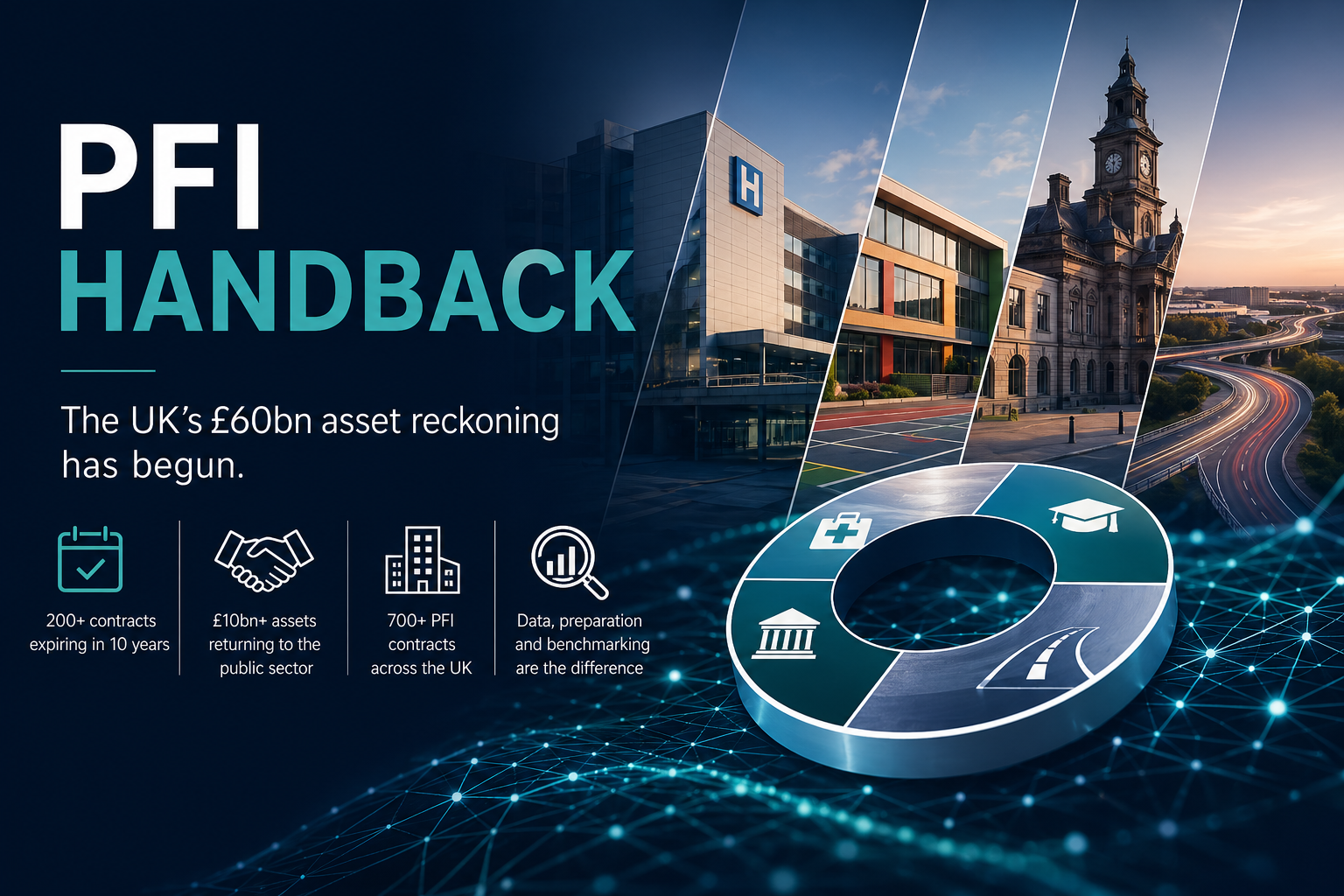
Why the next decade will define the future of public sector estates and why FM must lead
As a specialist PFI Benchmarking Consultancy, EMC’s perspective is grounded in the reality that data, performance insight, and early intervention are the difference between a controlled handback and a costly one.
Consultants Perspective
The UK’s PFI estate is entering a critical phase. With over 200 contracts set to expire in the next decade representing more than £10 billion in asset value public authorities face a defining moment in safeguarding asset condition, service continuity, and taxpayer value .
From a benchmarking standpoint, the challenge is not simply contractual compliance it is performance visibility. Many authorities are approaching expiry with fragmented data, inconsistent asset records, and limited insight into lifecycle investment versus actual asset condition. This creates a structural imbalance at precisely the moment when commercial leverage matters most.
Benchmarking across portfolios consistently reveals three systemic risks:
- Lifecycle underinvestment masked by poor data transparency
- Inconsistent contract management maturity across authorities
- Late-stage mobilisation, despite a recommended 7-year preparation horizon
At the same time, the sector is experiencing a shift in behaviour. The White Fraiser Review highlights that increased scrutiny and more rigorous contract management while necessary are often triggering disputes where strategy and alignment are lacking . This reinforces a key lesson: data without a clear strategy can escalate conflict rather than resolve it.
In this context, benchmarking becomes a strategic tool not just an analytical one. It enables authorities to:
- Establish an evidence-based view of asset condition and performance
- Compare lifecycle spend versus expected profiles
- Identify risk exposure early and prioritise intervention
- Support commercial positioning with objective, defensible data
Ultimately, successful handback is not achieved through retrospective audits, but through proactive, data-led contract management that aligns technical condition, commercial strategy, and stakeholder behaviour.
This article explores how a structured benchmarking approach can de-risk PFI expiry, strengthen negotiation positions, and ensure assets are handed back in the condition and value originally contracted.
The UK’s Private Finance Initiative (PFI) programme is entering its most critical phase.
After more than 25 years of delivery, the sector is now confronting a wave of contract expiries that will fundamentally reshape public estate ownership, asset performance, and facilities management delivery.
The scale is significant:
- Over 700 PFI contracts remain operational, representing ~£60bn in infrastructure
- Around 200 contracts will expire in the next decade, accelerating from 2025
- Assets worth more than £10bn will transfer back to the public sector
Yet, despite the scale, government reports consistently highlight a stark reality:
The UK is not fully prepared for PFI handback.
The consequences are clear without intervention, public bodies risk inheriting:
- Poorly maintained assets
- Unfunded lifecycle liabilities
- Disrupted frontline services
For FM leaders, this is not a distant legal milestone.
It is a live, multi-year transformation challenge and a defining moment for the profession.
A Sector at an Inflection Point
The White–Fraiser Report (2023) describes the PFI market as being at a “significant inflexion point”, with rising disputes, strained relationships, and underinvestment in contract management.
At the heart of the issue are three structural challenges:
1. Asset condition uncertainty
Late-stage lifecycle underinvestment and weak monitoring are creating hidden defects and deferred maintenance risks.
2. Capability gaps
Many public authorities lack the:
- Technical expertise
- Commercial capacity
- Data infrastructure
to effectively manage expiry.
3. Information asymmetry
Private sector operators often retain greater visibility of asset performance, leaving authorities at a disadvantage.
The result?
A growing risk that handback becomes a value leakage event, rather than a controlled transition.
Why FM is Central to Successful Handback
PFI handback is often framed as a legal or commercial exercise.
In reality, it is fundamentally an FM and asset management challenge.
Success depends on:
- Understanding true asset condition
- Validating lifecycle delivery vs contract obligations
- Planning future operating models
This requires FM teams to shift from:
Service delivery → Asset assurance and strategic estate leadership
The Critical Role of Forensic Benchmarking
In this environment, one capability stands above all others:
Forensic benchmarking
This is the discipline of independently validating asset performance, lifecycle investment, and service delivery against contractual and market benchmarks.
It goes far beyond traditional audits.
What it involves
- Lifecycle analysis – comparing planned vs actual spend
- Condition triangulation – aligning surveys, maintenance data, and performance records
- Service validation – testing self-reported KPIs against reality
- Market comparison – benchmarking costs and standards
Why it matters
Without forensic benchmarking, authorities risk:
- Paying twice for maintenance
- Accepting substandard assets
- Entering disputes without evidence
With it, they gain:
- Commercial leverage
- Risk visibility
- A defensible basis for decision-making
In short:
Forensic benchmarking is the bridge between contract and reality.
Sector Deep Dive: Where the Risks and Opportunities Lie
1. NHS Sector: High Risk, High Complexity
The NHS PFI portfolio is widely regarded as the most exposed.
Key characteristics
- Complex, 24/7 operational environments
- Large, ageing acute hospital estates
- Heavy reliance on soft and hard FM integration
Current challenges
- Rising disputes over lifecycle and asset condition
- Increasingly adversarial contract management approaches
- Workforce and capability constraints within Trusts
The White–Fraiser review highlights that:
Disputes in the health sector are higher than the market average and increasing.
Implications for FM
- Need for robust asset assurance programmes
- Integration of clinical priorities with technical handback planning
- Early development of post-PFI operating models
Opportunity
NHS organisations that adopt a structured “reset” approach—combining surveys, remediation plans, and collaboration—can:
- Reduce disputes
- Improve asset outcomes
- Protect service continuity
2. Education Sector: Fragmentation and Ownership Complexity
The education PFI estate—particularly schools—is defined by structural complexity.
Key characteristics
- Large number of smaller contracts
- High proportion of single-contract authorities
- Significant academy conversions
Core challenge
A unique misalignment exists:
- Local authorities manage the PFI contract
- Academy trusts inherit the asset at expiry
This creates:
- Weak incentives for investment
- Risk of “orphaned liabilities” at handback
Implications for FM
- Need for cross-organisation alignment (LA, academy, DfE)
- Clear definition of asset condition expectations
- Early engagement with future asset owners
Opportunity
Forensic benchmarking can:
- Provide a neutral evidence base across stakeholders
- Support transparent transition planning
- Avoid disputes between public bodies
3. Local Authority Estate: Capability and Resource Constraints
Local authorities hold over 80% of PFI contracts, yet often with the least resource.
Key characteristics
- Many authorities managing just one PFI contract
- Limited in-house expertise
- Competing budget pressures
Core risks
- Late mobilisation (missing the 7-year preparation window)
- Over-reliance on consultants without strategic oversight
- Inability to challenge SPV data effectively
Implications for FM
- Need to build internal intelligent client capability
- Use of portfolio-level benchmarking and data tools
- Early prioritisation of high-risk contracts
Opportunity
Authorities that take a programme approach—rather than contract-by-contract—can:
- Achieve economies of scale
- Share knowledge
- Improve consistency
4. Transport and Infrastructure: Mature but Commercially Complex
Transport PFIs (roads, street lighting, etc.) tend to be:
- More technically standardised
- Managed by more experienced authorities
However, risks remain.
Key challenges
- Complex performance regimes
- Long-term asset degradation risks
- Commercial disputes over performance interpretation
Implications for FM
- Focus on performance data validation
- Integration of asset management systems
- Ensuring lifecycle models reflect real-world conditions
Opportunity
These sectors are well-placed to lead on:
- Best practice dispute avoidance
- Data-driven asset management
- Portfolio-level optimisation
The “Reset” Opportunity
Across all sectors, there is growing recognition that:
A purely adversarial approach to handback is inefficient and value-destructive.
The White–Fraiser report identifies a clear alternative:
A collaborative “reset” model
This involves:
- Joint asset condition reviews
- Transparent lifecycle analysis
- Agreed remediation programmes
For FM leaders, this is a critical shift:
- From enforcement → optimisation
- From disputes → delivery
What Should Contract Managers Do Now?
1. Start early (≥7 years)
Late action erodes leverage and increases risk.
2. Invest in data and benchmarking
You cannot manage what you cannot evidence.
3. Build integrated teams
Technical, commercial, and operational alignment is essential.
4. Define the post-PFI model early
Handback is only successful if the day after expiry works.
5. Focus on outcomes, not just compliance
The goal is not contractual perfection—it is operational resilience and value.
A Defining Moment for PFI
PFI handback is one of the largest coordinated asset transitions the UK has ever undertaken.
It will test:
- Contract management capability
- Asset intelligence
- Leadership across FM and estates
But it also presents a unique opportunity:
To reset how public assets are understood, managed, and optimised.
Those who succeed will not be those who simply follow the contract.
They will be those who:
- Understand the data
- Challenge assumptions
- Lead the transition
And at the centre of that effort will be FM.
EMC’s Perspective
The approaching wave of PFI contract expiries represents both a material risk and a once-in-a-generation opportunity for public authorities to reset asset performance, commercial outcomes, and long-term service strategies.
The evidence is clear: without early, structured intervention, authorities risk inheriting assets in suboptimal condition, facing avoidable rectification costs, and entering into disputes that erode both value and relationships. At the same time, the combination of fragmented data, inconsistent contract management capability, and asymmetry of information continues to place the public sector at a disadvantage.
However, this outcome is not inevitable.
Our experience across complex PFI portfolios demonstrates that successful handback is driven by three critical enablers:
- Clarity – translating complex contractual obligations into actionable, time-bound operational plans
- Control – establishing a single source of truth for asset condition, lifecycle performance, and risk
- Capability – deploying the right blend of commercial, technical, and legal expertise at the right time
By embedding these principles through a structured, platform-enabled approach, authorities can move from reactive contract management to proactive value protection and enhancement.
Crucially, the handback phase should not be viewed as an audit exercise, but as a managed transition programme one that requires alignment across stakeholders, robust data, and a clear strategy for dispute avoidance and resolution. As highlighted by industry reviews, the path to successful outcomes lies in collaborative, well-informed engagement underpinned by strong contract management discipline, rather than adversarial, late-stage interventions.
At EMC, we combine hands-on delivery experience from some of the UK’s largest PFI programmes with digital tools that bring transparency, structure, and pace to the handback process. Our approach goes beyond identifying issues—we work alongside authorities to resolve them, protect value, and ensure assets are handed back in the condition originally intended.
As the expiry timeline accelerates, the message is simple:
those who act early, act with data, and act with clarity will secure better outcomes.
PFI Handback FAQ: What FM and Estates Leaders Need to Know
1. Why is PFI handback such a critical issue right now?
The UK is entering a concentrated expiry period, with over 200 PFI contracts ending in the next decade and billions of pounds of public assets transferring back to authorities.
This is not a routine transition. It is a high-risk, high-value event where:
- Asset condition must be validated
- Lifecycle obligations must be evidenced
- Future service models must be operational from day one
Failure to manage this effectively can result in significant unplanned capital expenditure, service disruption, and disputes.
2. What is the biggest risk at handback?
The single biggest risk is accepting assets in a condition below contractual requirements.
This is often driven by:
- Lifecycle underinvestment in later years
- Incomplete or unreliable asset data
- Over-reliance on self-reported performance
Without robust validation, authorities risk inheriting liabilities they have already paid for through the contract.
3. Why is early preparation (7+ years) so important?
Government guidance consistently recommends a minimum 7-year preparation window.
This is because handback requires time to:
- Understand complex contracts and variations
- Undertake condition surveys and lifecycle reviews
- Identify and enforce rectification works
- Develop post-expiry FM strategies
Late mobilisation reduces leverage and increases the likelihood of unresolved defects and disputes.
4. What is “forensic benchmarking” and why is it so important?
Forensic benchmarking is the process of independently analysing asset performance, lifecycle spend, and service delivery against contractual and market expectations.
It is critical because it:
- Provides evidence-based insight, not assumptions
- Identifies gaps between what was paid for and what was delivered
- Quantifies financial and operational risk exposure
- Strengthens commercial negotiation and dispute positioning
In practice, it is the difference between reacting to issues and proactively managing them.
5. Why can’t authorities rely on SPV reporting?
PFI contracts are fundamentally self-reporting, not self-monitoring.
The White–Fraiser review highlights that:
- Self-reporting mechanisms are not always reliable or complete
- Public authorities have historically been over-reliant on these reports
- Increased monitoring often reveals previously unidentified issues
Without independent validation, authorities lack assurance over actual performance and asset condition.
6. Why are disputes increasing in the PFI sector?
Disputes are increasing due to:
- More rigorous contract management by authorities
- Discovery of historic underperformance
- Lack of clarity around handback condition requirements
However, the White–Fraiser report makes it clear that:
Disputes are often a symptom of poor contract management and lack of clear strategy, not just behaviour
Without a structured approach, disputes can become costly, time-consuming, and value-destructive.
7. Can disputes be avoided?
Yes—many can.
Best practice is shifting toward a “reset” approach, which includes:
- Joint asset condition reviews
- Transparent lifecycle analysis
- Agreed rectification programmes
This approach:
- Reduces adversarial behaviours
- Focuses on outcomes rather than blame
- Preserves value within the asset
8. What role should FM teams play in handback?
FM teams are central to success.
Their role evolves from:
- Service delivery → Asset assurance → Operational ownership
They provide:
- Ground-truth validation of asset condition
- Insight into real performance vs reported performance
- Input into future operating models
Without FM leadership, handback risks becoming disconnected from operational reality.
9. What happens if you get handback wrong?
The consequences can be severe:
- Significant unfunded capital costs post-expiry
- Service disruption in critical environments (e.g. hospitals, schools)
- Prolonged legal disputes
- Loss of stakeholder confidence
In simple terms:
Poor handback transfers risk from the private sector to the public sector—at the worst possible time.
10. What does good look like?
A well-managed handback programme is:
- Early – mobilised 7+ years in advance
- Data-led – underpinned by accurate, centralised information
- Integrated – aligning technical, commercial, and operational teams
- Strategic – focused on outcomes, not just compliance
It results in:
- Assets returned in the correct condition
- Minimal disputes
- A smooth transition to post-PFI operations
11. How can organisations start improving their position now?
Immediate priorities should include:
- Establishing a baseline of asset and contract data
- Undertaking initial forensic benchmarking
- Assessing risk exposure across the portfolio
- Defining a clear handback strategy and governance model
The earlier these steps are taken, the greater the control and optionality available.
12. Why is this a strategic opportunity—not just a risk?
While risks are significant, handback also enables organisations to:
- Reset asset performance standards
- Optimise FM delivery models
- Improve long-term cost efficiency
- Reclaim control of critical infrastructure
Handled correctly, it is not just an endpoint it is a platform for future estate transformation.
Final Takeaway
PFI handback is not a passive process it is an active, data-driven programme that determines whether value is protected or lost.
For FM, estates, and commercial leaders alike, the question is no longer if this matters
but how prepared you are to manage it effectively.
Is your FM contract delivering what it should?
Book a free discovery call with an EMC consultant. Evidence led, no obligation.



Book a call with EMC
Tell us a little about your FM arrangements and we will come back within one working day to arrange a time.

