

University Catering Needs Benchmarking, Not Blunt Cuts
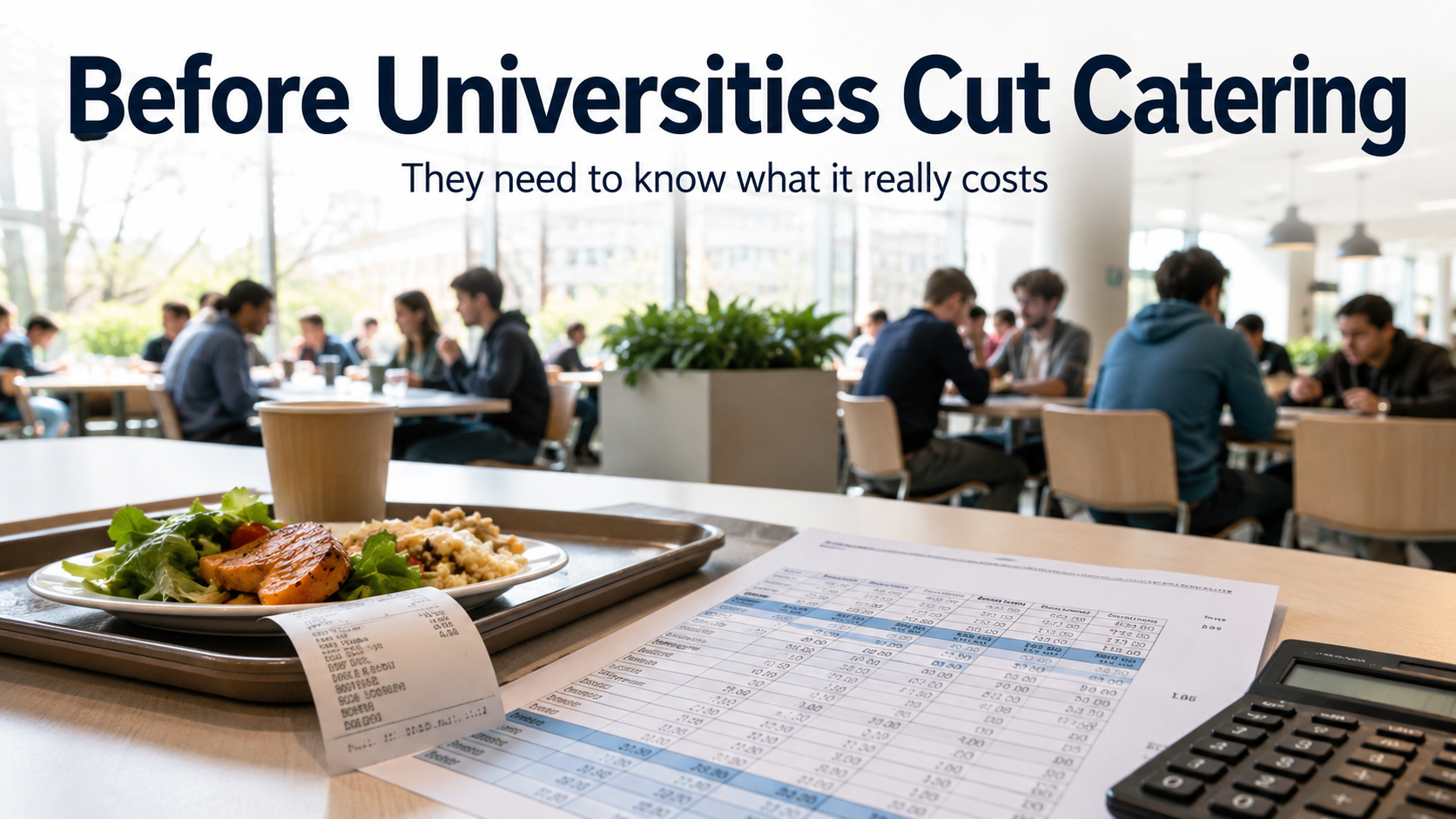
The financial pressure on UK universities is now impossible to treat as a passing squeeze.
The Office for Students’ latest financial sustainability work points to continued pressure from volatile recruitment, rising costs and optimistic income assumptions. Universities UK has also shown how far institutions are already going to protect core teaching activity, with many scaling back operational spend across estates, IT and catering.
The repairs and maintenance figure has understandably attracted attention. When universities defer maintenance, the risk is easy to visualise: ageing plant, compliance exposure, higher backlog costs and poorer campus conditions. But catering deserves the same level of scrutiny.
According to Universities UK, just over half of respondents had already cut catering costs, up sharply on the previous year. That matters because catering is often treated as one of the more flexible lines in the budget. It is visible, labour-intensive and exposed to food inflation, so it becomes an obvious target when finance teams are looking for quick savings.
The danger is that universities cut before they understand.
A catering service can be expensive for many different reasons. Labour may be misaligned to demand. Opening hours may reflect historic habit rather than current footfall. Menus may be carrying too much complexity. Purchasing may lack leverage. Waste may be tolerated because it is hidden inside routine operations.
Contractor margins may be poorly understood. Subsidy may be supporting the wrong parts of the offer. Or the institution may simply be asking catering to do three jobs at once: provide affordable student food, deliver commercial income and support events, hospitality and reputation.
Those are very different problems. They require different remedies. A blanket cut will not distinguish between them.
This is where forensic benchmarking becomes essential.
Before universities reduce service, retender contracts or push additional risk onto suppliers, they need a clear picture of what the catering operation is actually doing and what it is costing.
That means going beyond headline sales, subsidy figures and anecdotal student feedback.
A serious review should look at income by outlet, daypart and term cycle; labour deployment against trading patterns; gross margin by product category; food cost movement; waste; tariff strategy; supplier terms; allergen and compliance requirements; sustainability commitments; events income; space utilisation; and the true split between commercial, welfare-led and strategic activity.
Without that level of analysis, catering decisions are too easily driven by whichever number is most visible. A high subsidy may look like inefficiency when in fact it is supporting affordability in a campus with limited external food provision.
A profitable outlet may look healthy while masking weak value perception among students. A contractor’s price may look attractive until service resilience, investment, mobilisation risk and tariff increases are properly tested.
The sector data also shows why this is not a marginal issue. CUBO’s 2025 benchmarking summary reported average catering income of £4.77 million per institution and noted that university menu inflation had been held significantly below wider food inflation over the 2022 to 2024 period. In other words, university catering teams are already operating in a difficult space: absorbing inflation, managing affordability and still being expected to contribute commercially.
That balancing act is becoming harder.
Students are price-sensitive. Staff expect quality and convenience. Universities want vibrant campuses, better dwell time, stronger events income and services that support recruitment and retention.
At the same time, sustainability, nutrition, local sourcing, allergen management and waste reduction all carry real operational implications. None of these pressures disappears because the budget line is reduced.
The answer is not to argue that catering should be protected from scrutiny. It should be scrutinised closely. But it should be scrutinised intelligently.
For some universities, the right answer may be a smaller catering estate with fewer but stronger outlets. For others, it may be a revised contractor model, a more disciplined tariff structure, a better events strategy, smarter use of technology or a clearer distinction between commercial catering and subsidised student support. Some institutions may need to stop pretending every outlet can be profitable. Others may need to stop accepting underperformance as inevitable.
The point is that these choices should be made with evidence, not assumption.
A weak catering review asks: “How much can we cut?”
A better one asks:
“What is this service for, where is value being created, where is cost being wasted, and what operating model will still make sense in three years’ time?”
That distinction matters. If universities cut catering crudely, they may save money on paper while damaging student experience, reducing campus footfall, weakening commercial income and storing up contract problems for the next procurement cycle.
If they benchmark properly, they can make sharper choices: protecting what matters, challenging what does not, and building catering models that are affordable without being hollowed out.
The funding crisis is forcing universities to make decisions they would rather avoid. But catering should not be treated as a soft target simply because it is visible and operationally complex. In many institutions, it is part commercial service, part student support, part workplace offer and part campus identity.
That is exactly why it needs better evidence behind it.
Before universities take the knife to catering, they need to know what it really costs, what it really contributes and what would be lost if the wrong cut is made.
Consultant’s Conclusion
The pressure on university catering budgets is real, and it would be unrealistic to argue that catering should sit outside wider cost review. But the critical issue is not whether catering should be challenged. It is whether universities have enough evidence to challenge it properly.
In our experience, catering costs are often debated through partial information: subsidy levels, headline sales, supplier prices, student complaints or historic operating assumptions. Those indicators matter, but none of them tells the whole story. A catering operation may be underperforming because of labour deployment, procurement, menu design, outlet location, opening hours, poor demand forecasting, weak contract management or unrealistic service expectations. Without forensic benchmarking, those causes are easily confused.
That is where universities risk making a false economy. A blunt reduction in catering provision may deliver a short-term saving, but it can also weaken student experience, reduce campus dwell time, undermine events income and create fresh pressure in the next tender cycle. Conversely, a properly benchmarked review can identify where cost can be removed, where value should be protected and where the operating model needs to change.
For universities, the practical message is clear: do not start with the cut. Start with the evidence.
Before reducing service levels, retendering contracts or pushing more risk onto suppliers, institutions should understand what their catering service really costs, what it contributes commercially and strategically, and which parts of the model are viable, subsidised or misaligned. In the current funding climate, smart catering decisions will not come from instinct or precedent. They will come from disciplined benchmarking, honest commercial analysis and a clear view of what the campus food offer is there to achieve.
FAQ: University Catering Benchmarking And Cost Review
Why should universities benchmark catering before making cuts?
Because catering costs can be driven by many different factors. Without benchmarking, institutions may cut the wrong part of the service, remove income-generating activity, damage student experience or weaken supplier performance. Benchmarking helps distinguish genuine inefficiency from necessary cost.
Is university catering usually expected to make a profit?
It depends on the institution and the operating model. Some outlets may be expected to generate margin, while others may exist to support affordability, student welfare, campus life or events. The key is to define which parts of the service are commercial, which are strategic and which are deliberately subsidised.
What should a catering benchmark review include?
A robust review should examine sales, subsidy, labour cost, food cost, gross margin, purchasing terms, waste, outlet performance, opening hours, menu complexity, footfall patterns, tariff strategy, compliance obligations, event income, student affordability and contract structure.
Can catering costs be reduced without damaging the student experience?
Yes, but only when reductions are targeted. For example, universities may be able to adjust opening hours, simplify menus, reduce waste, improve purchasing, consolidate low-performing outlets or redesign staffing around demand. Poorly targeted cuts are much more likely to affect quality, access and satisfaction.
Should universities retender catering contracts to reduce costs?
A retender can help, but only if the university has first clarified its requirements and tested the current model. If the underlying brief is unclear or contradictory, the tender may simply transfer risk to bidders, encourage unrealistic pricing or create service problems later.
What is the risk of pushing too much cost pressure onto catering contractors?
Suppliers will normally respond to risk through pricing, reduced investment, tighter staffing, higher tariffs or more cautious service commitments. A contract that looks cheaper at award can become more expensive or less effective once operational reality catches up.
How does catering affect wider campus performance?
Catering influences student satisfaction, staff experience, campus dwell time, events income, space utilisation and perceptions of value for money. It is not just a food service; it is part of how the campus functions day to day.
What are the warning signs that a university catering model needs review?
Common warning signs include rising subsidy without clear explanation, falling footfall, poor value perception, inconsistent outlet performance, high waste, repeated contractor disputes, unexplained labour cost increases, weak event conversion or a tender specification that no longer reflects current demand.
How often should university catering be benchmarked?
At minimum, a detailed review should take place before any major tender, contract extension or service reduction. In the current financial climate, universities should also monitor key indicators regularly so that decisions are based on current trading patterns rather than historic assumptions.
What is the most important question university leaders should ask?
Not simply “how much does catering cost?” but “what value is catering expected to deliver, and is the current model the best way to deliver it?” That question creates a stronger basis for cost control, service quality and future procurement.
Is your FM contract delivering what it should?
Book a free discovery call with an EMC consultant. Evidence led, no obligation.


Book a call with EMC
Tell us a little about your FM arrangements and we will come back within one working day to arrange a time.

